
Corporate income tax and the reduced rate
Corporate income tax (impôt des sociétés / vennootschapsbelasting) depends on the profit, but also on the company: an SME that meets the conditions of Article 215 of the Income Tax Code 1992 (ITC 92; CIR 92 / WIB 92) pays 20% on its first €100,000. Fiplan applies these rates, checks the conditions it can measure, and asks you for the others.
What it is for
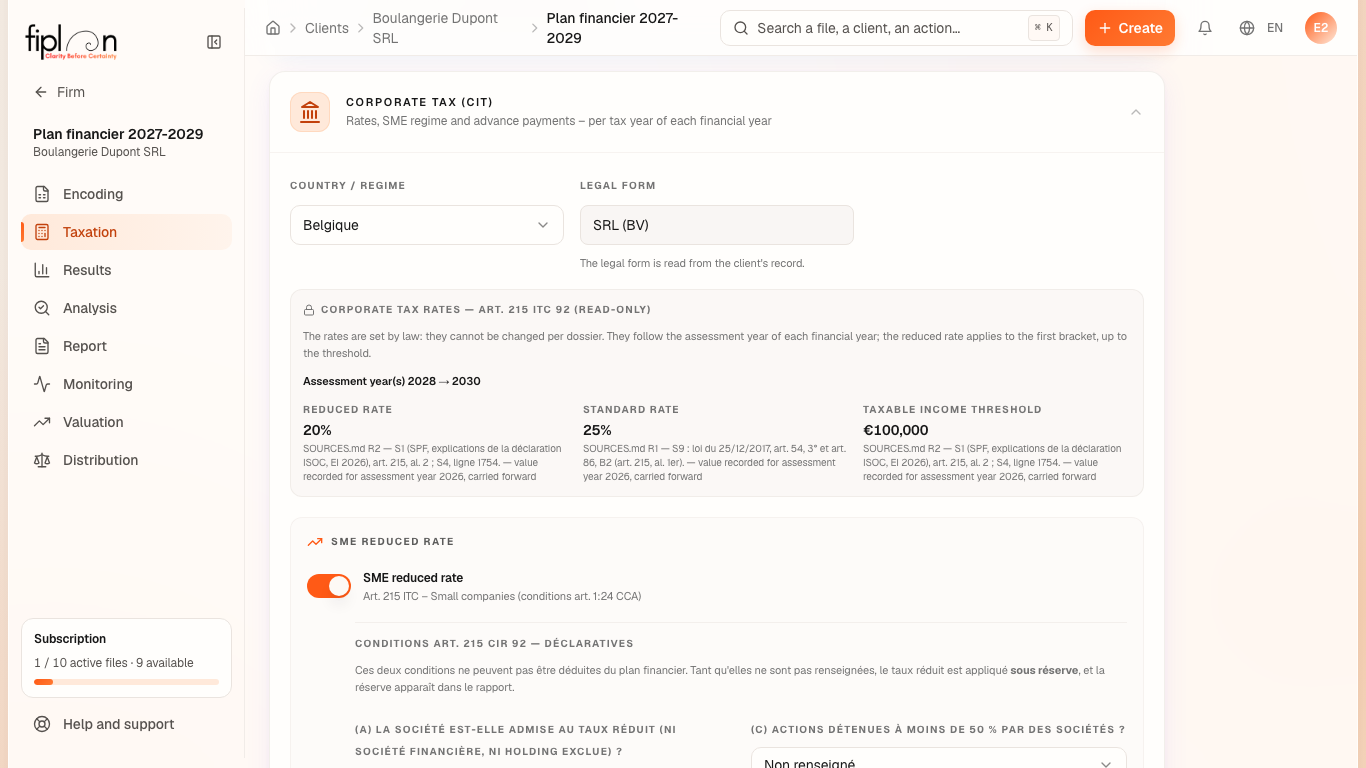
Each financial year falls under a tax year (exercice d'imposition / aanslagjaar): a financial year closed on 31 December 2027 falls under tax year 2028. Fiplan reads the rates of that tax year; for a year that the Federal Public Service Finance (FPS Finance; SPF Finances / FOD Financiën) has not yet published, it applies the most recent published rates, and the Taxation tab shows them read-only, with their source.
The reduced rate (taux réduit / verlaagd tarief) requires five conditions, as Fiplan checks them:
| Condition | How Fiplan knows it |
|---|---|
| (a) the company is not a financial company or an excluded holding company | your answer, Taxation tab |
| (b) a company director (dirigeant d'entreprise / bedrijfsleider) receives at least the minimum remuneration (or the taxable income, if it is lower) | the plan's 6181 lines; not applicable during the first 4 taxable periods (périodes imposables / belastbare tijdperken) |
| (c) the shares are not held for 50% or more by other companies | your answer, Taxation tab |
| (d) the company is small (petite société / kleine vennootschap) within the meaning of art. 1:24 of the Companies and Associations Code (CAC; CSA / WVV) | calculated: revenue, balance sheet total, headcount |
| (e) from tax year 2027, the directors' benefits in kind do not exceed 20% of their remuneration | read on the directors' lines (see Director's remuneration); with no benefit entered, the condition does not apply |
Steps
- Open the file, Taxation tab, Corporate Tax (CIT) section.
- Read the rates, shown read-only: reduced rate, standard rate, threshold, each with its source.
- Leave SME reduced rate switched on and answer conditions (a) and (c): “Oui”, “Non” or “Non renseigné” (yes, no, not answered; Fiplan shows these options in French).
- If you know it, enter the Moyenne annuelle des travailleurs (annual average number of employees).
- Click Save tax parameters, then open the file's checks badge: the “SME reduced-rate eligibility” check has turned OK, or what is at stake now names only the missing condition.
Worked example · Boulangerie Dupont SRL
The bakery's 2027 financial year falls under tax year 2028; the rates applied are those of 2027, the most recent: 20% up to €100,000, 25% above. Its taxable base is €104,101.51:
At the ordinary rate on the whole base, the tax would be €26,025.38.
The conditions, as Fiplan reports them for 2027:
- (a) Exclusion financière/holding à confirmer; (c) Structure d'actionnariat à confirmer: the bakery has not answered them yet;
- (b) Rémunération dirigeant — Période imposable 1 sur les 4 premières depuis la constitution — condition non applicable (art. 215 CIR 92);
- (d) Petite société art. 1:24 CSA.
(Fiplan shows these messages in French.)
Two conditions are missing: Fiplan applies the reduced rate subject to a reservation. The “SME reduced-rate eligibility” check of the badge turns to Warning and puts a figure on what losing the reduced rate would cost: €5,000.00 per financial year, €15,000.00 over the plan; the PDF report states it too. As soon as (a) and (c) are answered “Oui”, each financial year becomes “eligible for the reduced rate”, the check turns OK and the reservation disappears; the tax does not change (€21,025.38).
Pitfalls
What it changes · 2027
Source
Art. 215 ITC 92: the 25% rate (para. 1, Law of 25 December 2017, art. 54, 3° and 86, B2); the reduced rate of 20% on the first bracket of €100,000 (para. 2); the minimum remuneration of €45,000, or the taxable income (para. 3, 4°), not applicable before the 5th taxable period since incorporation — FPS Finance, explanatory notes to the corporate income tax return, tax years 2024 to 2026. From tax year 2027: €25,000, adjusted every year to the consumer price index and rounded to the thousand — Law of 15 July 2026, art. 80 and 88 (Belgian Official Gazette, 29 July 2026) —, i.e. €51,000 for tax year 2027 (coefficient 2.0592, indexation notice, Belgian Official Gazette, 12 August 2026). Condition (e): art. 215, para. 3, 5° and art. 2, § 1, 25° ITC 92, from tax year 2027 — Law of 15 July 2026, art. 76, 80 and 88.
Art. 1:24, § 1 CAC: the small company (50 employees, €11,250,000 of revenue excluding VAT, €6,000,000 of balance sheet total — no more than one criterion exceeded).
FPS Finance, filing calendar: the tax year of a financial year closed on 31 December is the following year.
The values and their status are kept in src/lib/tax-rules/ and docs/references/fiscal/SOURCES.md (R1, R2, R5, R5b, R6, T1).