
The two tests: net assets and liquidity
How much may the company distribute? Two answers, and the smaller one prevails: the net assets answer (what remains above unavailable equity) and the cash answer (the lowest point after the payment, against zero and your comfort threshold).
What it is for
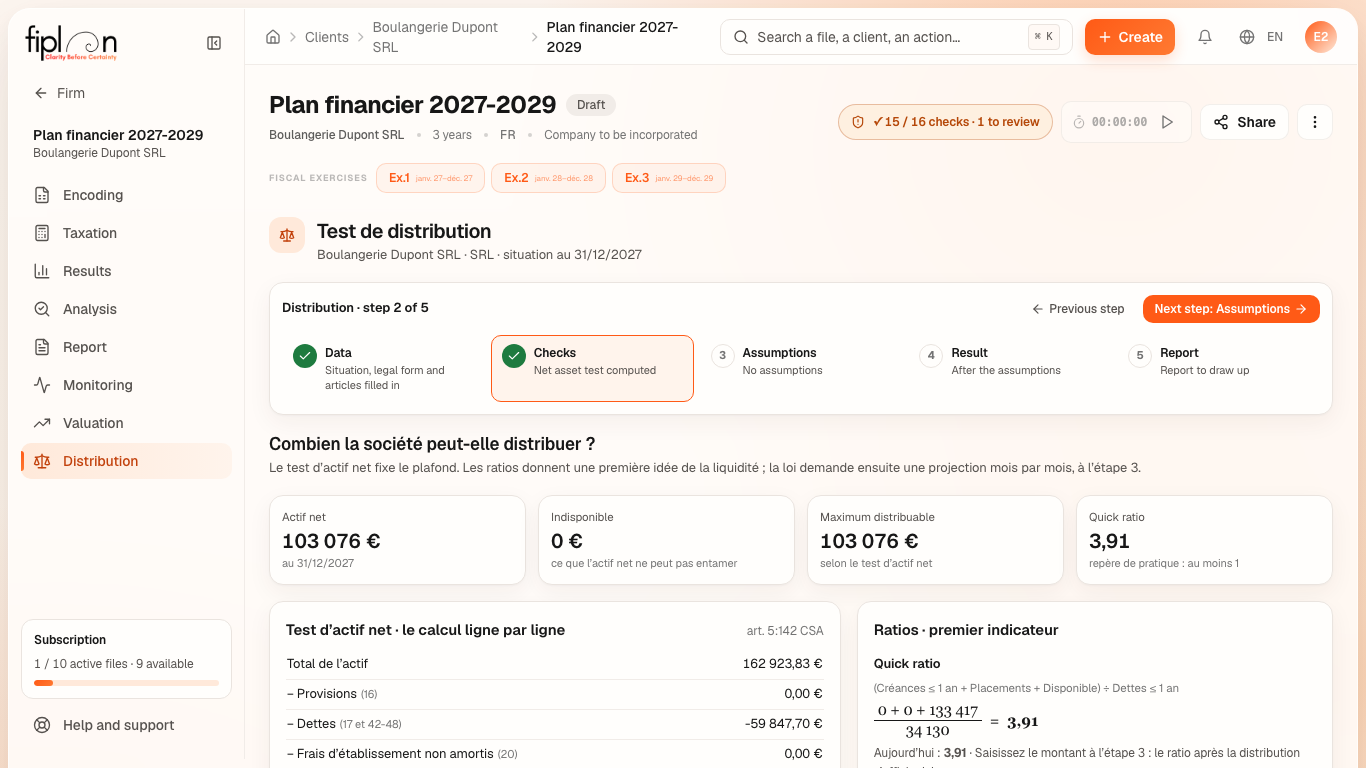
Step ② “Combien la société peut-elle distribuer?” (how much can the company distribute?) runs the net asset test on the chosen position and shows the liquidity ratios; step ④ Result adds the liquidity test, calculated on the step ③ projection, and the verdict. Nothing is hidden: every amount opens on its calculation. The module's screen is in French.
- Net assets: total assets, less provisions (16), debts, and unamortised formation expenses (20) and research and development costs (210).
- Unavailable: what net assets may not eat into. For a BV/SRL or a CV/SC: the unavailable contribution (111, the uncalled part deducted), the former legal reserve (130), unavailable reserves (131), capital grants (15) and revaluation surpluses (12). For an NV/SA: paid-up or called capital, reserves that the law or the articles do not allow to be distributed, and the unamortised revaluation surplus.
- Maximum distributable = net assets − unavailable. A cross-check recalculates it from the liabilities side (equity − unavailable − unamortised formation and R&D costs): both paths must give the same amount.
- Liquidity test (BV/SRL, CV/SC): after the payment, the company must be able to pay its debts for at least twelve months. Fiplan measures it on month-end cash in each scenario: it must never fall below zero. An NV/SA is not bound by it; Fiplan calculates it anyway, “recommended by practice”.
Steps
- At step ②, read the four indicators: “Actif net”, “Indisponible”, “Maximum distribuable”, “Quick ratio”. Open “Test d'actif net · le calcul ligne par ligne” (net asset test · the line-by-line calculation): each line carries its accounts; the cross-check follows.
- Read the ratios, today and after the amount: “Quick ratio” (receivables within one year, cash investments and cash, divided by debts within one year) and “Liquidité générale” (inventories, receivables within one year, cash and accruals, divided by the same debts). The benchmark of 1 is a practice benchmark, not a legal rule.
- At step ③, the projection runs from the payment month to at least twelve months later. The “Base” and “Prudent” scenarios are always calculated; add “Perte d'un client important” (loss of a major customer), “Dépense imprévue” (unexpected expense) or “Hausse des coûts” (rising costs) with their parameters. A table cell can be changed by hand with “Modifier la case” (change the cell), with a note: it is marked “modifié à la main” (changed by hand).
- At step ④, read the two cards “Test d'actif net” (net asset test) and “Test de liquidité” (liquidity test), then each scenario's lowest point. “D'où vient …?” (where does … come from?) breaks that lowest point down: cash of the previous month, flows of the month.
- “Combien distribuer?” returns one amount per test: according to net assets, the maximum; according to liquidity, for each scenario, intended amount + (lowest point − comfort threshold). The smallest prevails; one click takes it back to step ③ and everything is recalculated.
- Answer the three questions of “Est-ce raisonnable?” (is it reasonable?) — “Oui”, “Non” or “Sans objet” (yes, no, not applicable), with a comment: no answer is inferred, it is the firm's judgement. They go into the report.
Worked example · Boulangerie Dupont SRL
Position: “Les chiffres du plan” (the plan figures) at 31 December 2027; gross dividend of €20,000.00 paid on 30 June 2028.
| Net asset test (art. 5:142 BCCA) | Amount |
|---|---|
| Net assets | €103,076.13 |
| − distribution | €20,000.00 |
| = Net assets after | €83,076.13 |
| − unavailable | €0.00 |
| = Margin | €83,076.13 |
| Liquidity test (art. 5:143 BCCA), from 30 June 2028 to 30 June 2029 | Lowest point |
|---|---|
| Base scenario · June 2028 | €141,976.88 |
| Prudent scenario · July 2028 | €128,253.00 |
The ratios go from 3.91 to 3.32 (quick ratio) and from 3.99 to 3.41 (current ratio) after the dividend.
“Combien distribuer?”: according to net assets, €103,076.13; according to liquidity, €156,976.88 (base) and €143,253.00 (prudent), with the comfort threshold of €5,000.00. The smallest is €103,076.13: here, net assets are the limit.
Decided by the directors (art. 5:141 BCCA, articles that allow it): the distribution only takes profit. On the same position, the plan has already moved the 2027 result to account 14 at closing: result of the year €0.00 + result carried forward €83,076.13 = limit of €83,076.13, without reserves.
Pitfalls
What it changes · 2028
Source
Net assets and unavailable equity: art. 5:142 BCCA (BV/SRL), 6:115 (CV/SC, the BV/SRL rule), 7:212 (NV/SA; the unamortised revaluation surplus “treated as a legally unavailable reserve”) — src/lib/tests-distribution.ts, docs/references/affectation/SOURCES.md A7, A10; NV/SA: CBN/CNC opinion 2021/02; BV/SRL: IBR/IRE technical note 2019/15. Liquidity: art. 5:143 (BV/SRL) and 6:116 (CV/SC), at least twelve months from the payment (A8). Directors' limit: art. 5:141 (BV/SRL), 6:114 (CV/SC), 7:213 (NV/SA, interim dividend), quoted verbatim in A6 and A11. The ratios and their benchmark of 1: practice, not a legal rule.