
KPIs, distribution capacity and sensitivity
What if sales fell by 10%? How much can the company distribute? Can it repay its debts? Analysis answers these questions on the plan as it is entered, without changing it.
What it is for
In Analysis, the KPI & Insights tab gives each financial year a badge — OK, WATCH or RISK — based on the EBITDA margin, cash, the DSCR and the distribution capacity. Three blocks follow: Distribution Capacity, Performance Drivers and Sensitivity Analysis. The Thresholds button sets the file's alert thresholds.
Steps
- Open Analysis, KPI & Insights tab, and choose the financial year.
- Read the Distribution Capacity: the tests of Belgian law, the legal maximum and the prudent recommendation.
- Read the Performance Drivers: the five lines that weigh most on EBITDA and on cash.
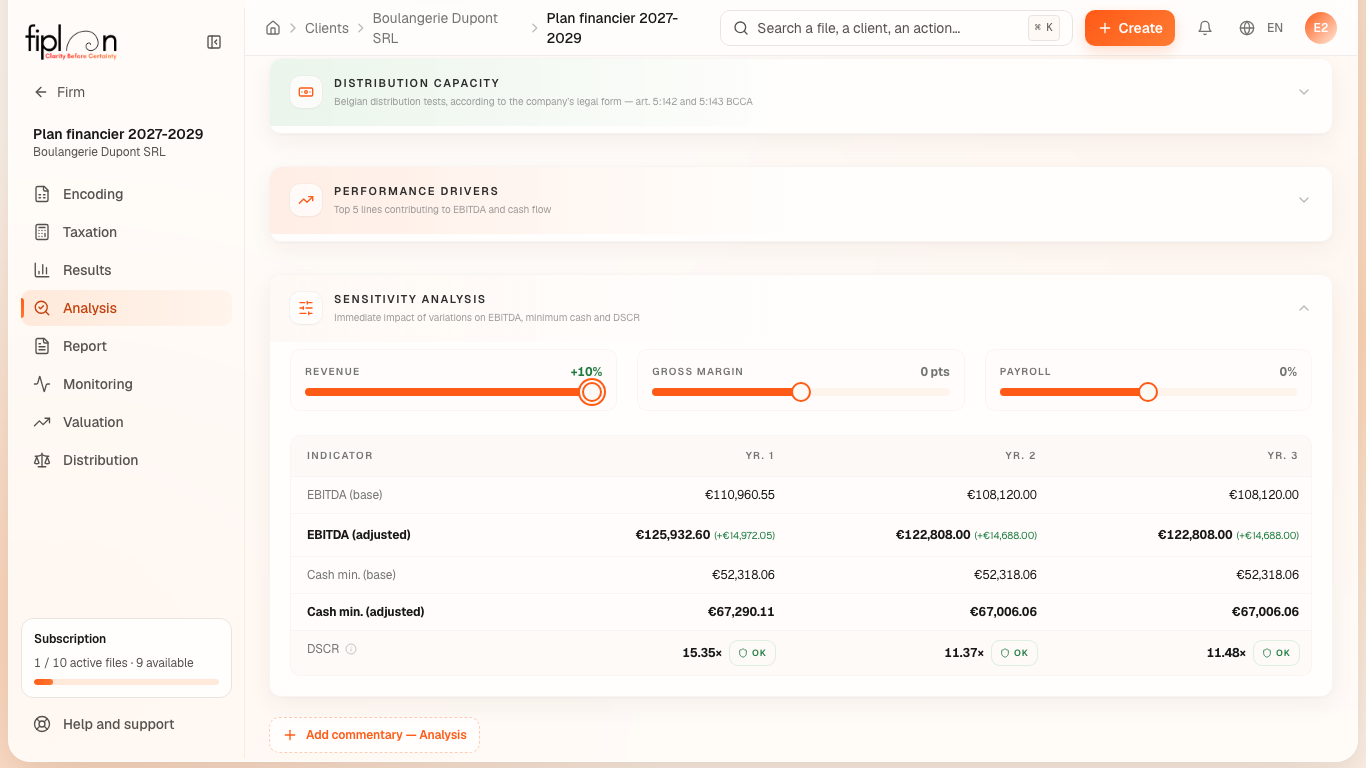
- In the Sensitivity Analysis, move the sliders: revenue (−10% to +10%), gross margin (−2 to +2 points), payroll (−5% to +5%).
Worked example · Boulangerie Dupont SRL
The DSCR (debt service coverage ratio) for 2027: EBITDA , minus taxes paid , divided by debt service — the capital repaid and the interest paid , read in cash.
The screen shows 13.53×. In 2028, the 2027 tax is paid (€21,025.38): the DSCR falls to 9.73×.
Sensitivity: revenue at +10% in 2027 brings EBITDA to €125,932.60 (+€14,972.05) — supplies follow sales, so the margin as a percentage stays the same.
Distribution: for 2027, the prudent recommendation is €62,345.17, capped by the solvency test (equity minus 25% of the balance sheet total); the legal maximum, under the net asset and liquidity tests (test d'actif net, test de liquidité / netto-actieftest, liquiditeitstest), is €103,076.13.
Pitfalls
What it changes · 2027
Source
Companies and Associations Code (CSA / WVV): the net asset test (Article 5:142, for the private limited company (SRL / BV)) and the liquidity test (Article 5:143).
Fiplan conventions (capacite-remboursement.ts, sensibilite.ts, capacite-distribution.ts): the DSCR read from the journal (taxes, capital and interest paid in cash); the adjusted EBITDA starting from the engine's EBITDA; the default thresholds (liquidity floor, minimum solvency); the recommendation capped at the result for the year.