
Reading the income statement
The income statement answers the question “is the business making money?”. Fiplan reads it from the plan's journal: each line entered reaches it through its entries, with tax calculated in two passes.
What it is for
At the top of Results, four cards summarise the first financial year: Turnover · Yr 1, Net result · Yr 1, Cash at end of Yr 1 and VAT balance · Yr 1. The Income Statement tab then shows, from top to bottom:
- the table, one column per financial year; the headings expand to show the lines they are made of;
- the two charts, side by side: Multi-year evolution and Margins (%);
- at the very bottom, collapsed, the Tax assumptions used block, when Fiplan had to assume something in order to calculate corporate income tax (impôt des sociétés / vennootschapsbelasting).
No tax caveat is shown above the table any more: what needs a correction — the reduced rate subject to confirmation, a missing date of incorporation, a line that does not comply — is read in the Plan checks, from the file's checks badge.
Steps
- Open the file, then Results, Income Statement tab.
- Read the four cards at the top: they are rounded to the euro.
- Expand a heading (▸) to see its lines, with their account in the Belgian minimum chart of accounts (PCMN / MAR).
- Below the table, pin a chart to the report with Pin to report.
- At the bottom, expand Tax assumptions used if it is shown: these are the points of the tax calculation to know.
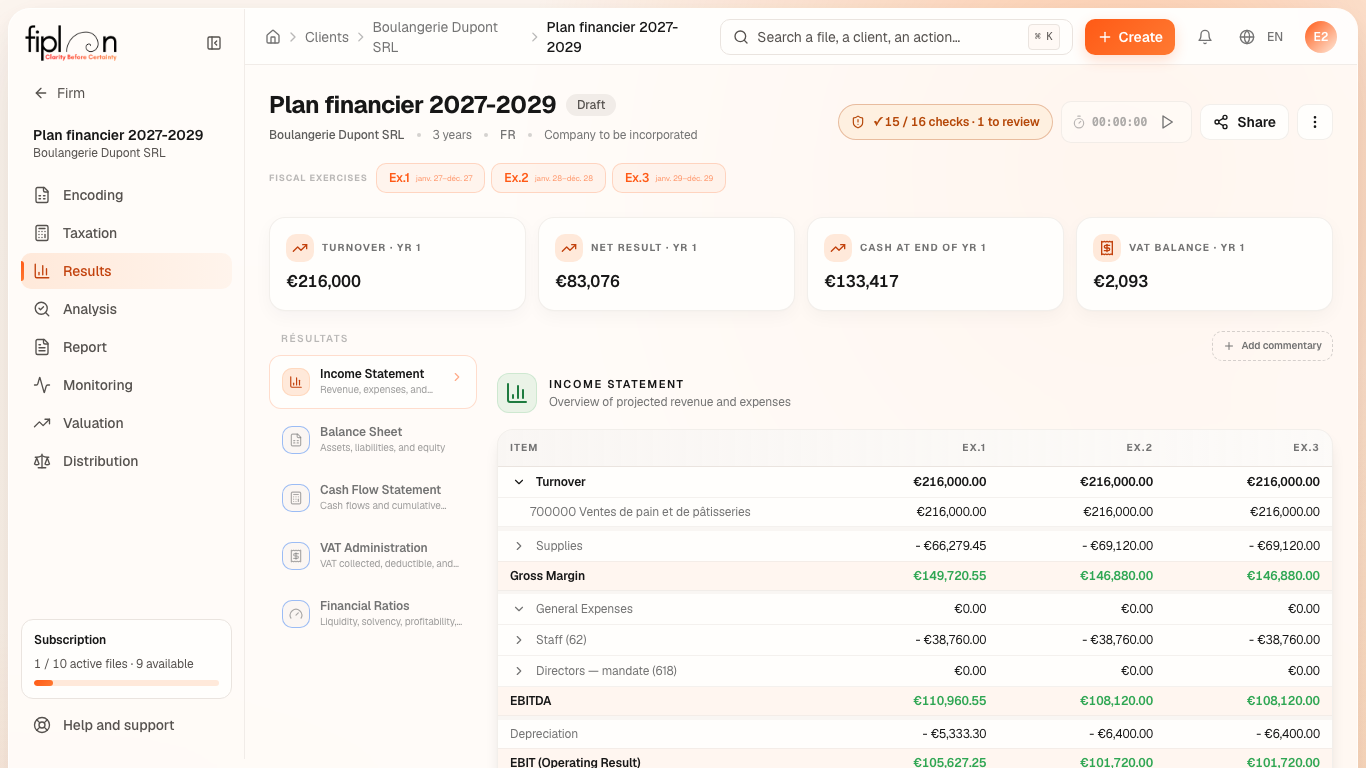
Worked example · Boulangerie Dupont SRL
The bakery's four cards: €216,000 of turnover, €83,076 of net result, €133,417 of cash at 31 December 2027 and €2,093 of VAT balance.
The table, as the screen displays it:
| Heading | 2027 | 2028 | 2029 |
|---|---|---|---|
| Turnover | 216,000.00 | 216,000.00 | 216,000.00 |
| Supplies | 66,279.45 | 69,120.00 | 69,120.00 |
| Gross Margin | 149,720.55 | 146,880.00 | 146,880.00 |
| General Expenses | 0.00 | 0.00 | 0.00 |
| Staff (62) | 38,760.00 | 38,760.00 | 38,760.00 |
| Directors — mandate (618) | 0.00 | 0.00 | 0.00 |
| EBITDA | 110,960.55 | 108,120.00 | 108,120.00 |
| Depreciation | 5,333.30 | 6,400.00 | 6,400.00 |
| EBIT (Operating Result) | 105,627.25 | 101,720.00 | 101,720.00 |
| Financial charges (interest) | 1,525.74 | 1,343.95 | 994.60 |
| EBT (Earnings before tax) | 104,101.51 | 100,376.05 | 100,725.40 |
| Corporate Tax (CIT) | 21,025.38 | 20,094.01 | 20,181.35 |
| Net result after tax | 83,076.13 | 80,282.04 | 80,544.05 |
Four points to read:
- The supplies for 2027 equal the purchases (€69,120.00) minus the stock built up (€2,840.55): this is the cost of the materials consumed.
- Staff includes the shop assistant and the employer's social security contributions (cotisations patronales / werkgeversbijdragen) on her pay.
- The depreciation for 2027 covers only ten months: the van arrives in March.
- The Tax assumptions used block does not appear: the report's 2 tax assumptions are reduced-rate reservations, to be cleared in the Taxation tab; the screen shows them in the “SME reduced-rate eligibility” check.
Pitfalls
What it changes · 2027
Source
Fiplan convention: the income statement, the balance sheet and cash flow are drawn from the same journal (the engine writes each line in double entry); tax is calculated on the profit before tax of a first pass, then posted by a second. The headings follow classes 6 and 7 of the minimum standard chart of accounts (plan comptable minimum normalisé / minimumindeling van een algemeen rekeningenstelsel). What needs a correction is placed in the checks (financial-controls.ts), what is to be known at the bottom of the screen (reserves-fiscales.ts): a single function writes these lines for the screen, the PDF and the Excel file.