
Importing the prior-year (N-1) balance sheet of an existing company
A company that already exists does not start from an opening balance sheet: it starts from its closing balance sheet. Fiplan takes it over as “opening entries” on the first day of the plan, heading by heading, and checks that it balances.
What it is for
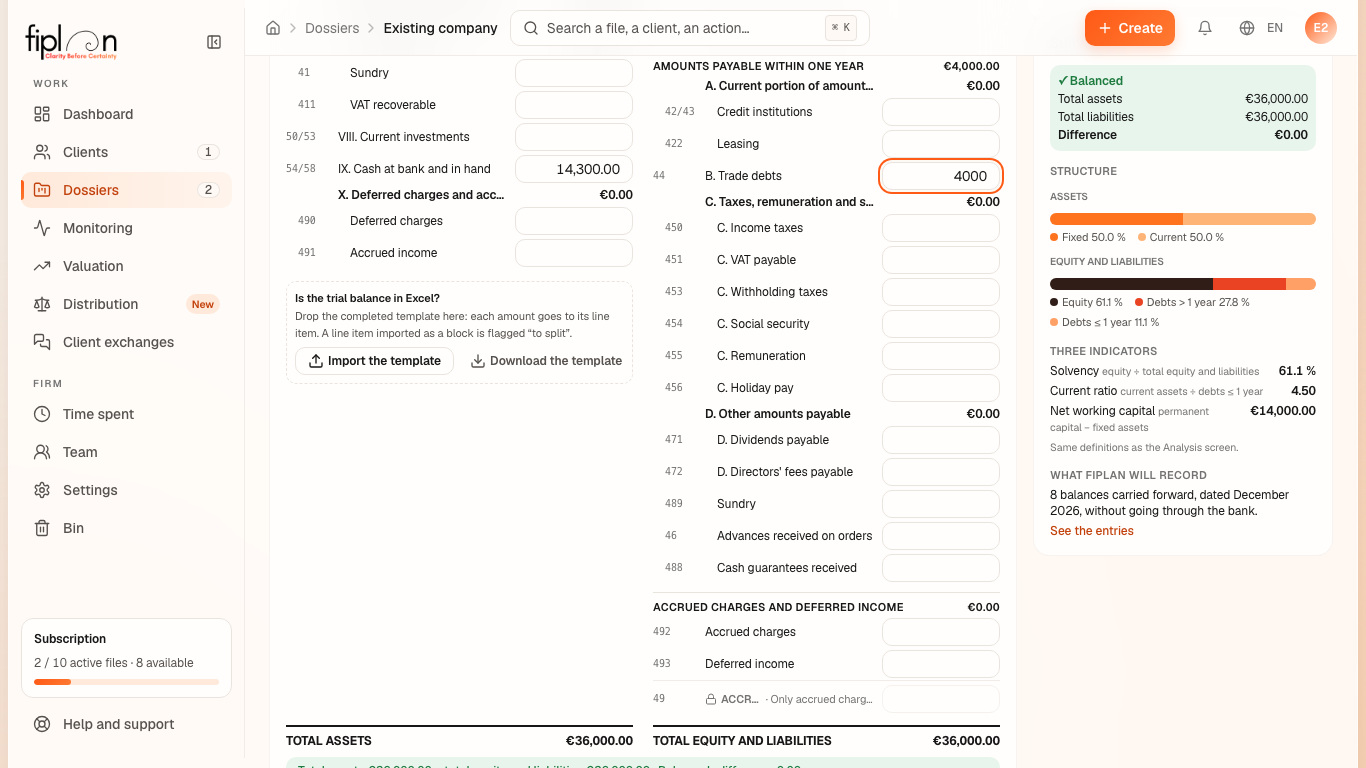
Step 2 · Balance sheet N-1 of the “Existing company — N-1 balance sheet” page shows the balance sheet as in the annual accounts: ASSETS and EQUITY AND LIABILITIES side by side, in net values, in the layout of the National Bank of Belgium (BNB / NBB). Each heading shows its code on the left; the sections (FIXED ASSETS, EQUITY…) and the headings in Roman numerals show their subtotal; at the bottom, on the same line, TOTAL ASSETS and TOTAL EQUITY AND LIABILITIES. Under the table, a bar shows whether it balances: green (“Balanced · difference 0.00”) or orange (“… missing on the liabilities side”, or “on the assets side”).
An Excel template (bilan-n1-template.xlsx, two sheets, ASSETS and LIABILITIES) can be downloaded, filled in and imported back: with the buttons above the balance sheet, or with the “Is the trial balance in Excel?” box under the assets.
On the right, the Summary panel stays visible:
- the balance check: “✓ Balanced”, the total assets, the total liabilities and the difference;
- the structure: two bars, the assets (fixed, current) and the liabilities (equity, provisions, debts > 1 year, debts ≤ 1 year), in percent;
- three indicators: solvency (equity ÷ total equity and liabilities), the current ratio (current assets ÷ debts ≤ 1 year) and net working capital (permanent capital − fixed assets) — “Same definitions as the Analysis screen.”;
- what Fiplan will record: the number of balances carried forward and their date; See the entries shows the entries and the balance sheet they produce.
Steps
- Click New Dossier, then Existing company, and fill in step 1 (see Creating a file).
- In step 2 · Balance sheet N-1, enter each heading — or click Download the template, fill in only the yellow cells, then Import the template: each amount goes to its heading.
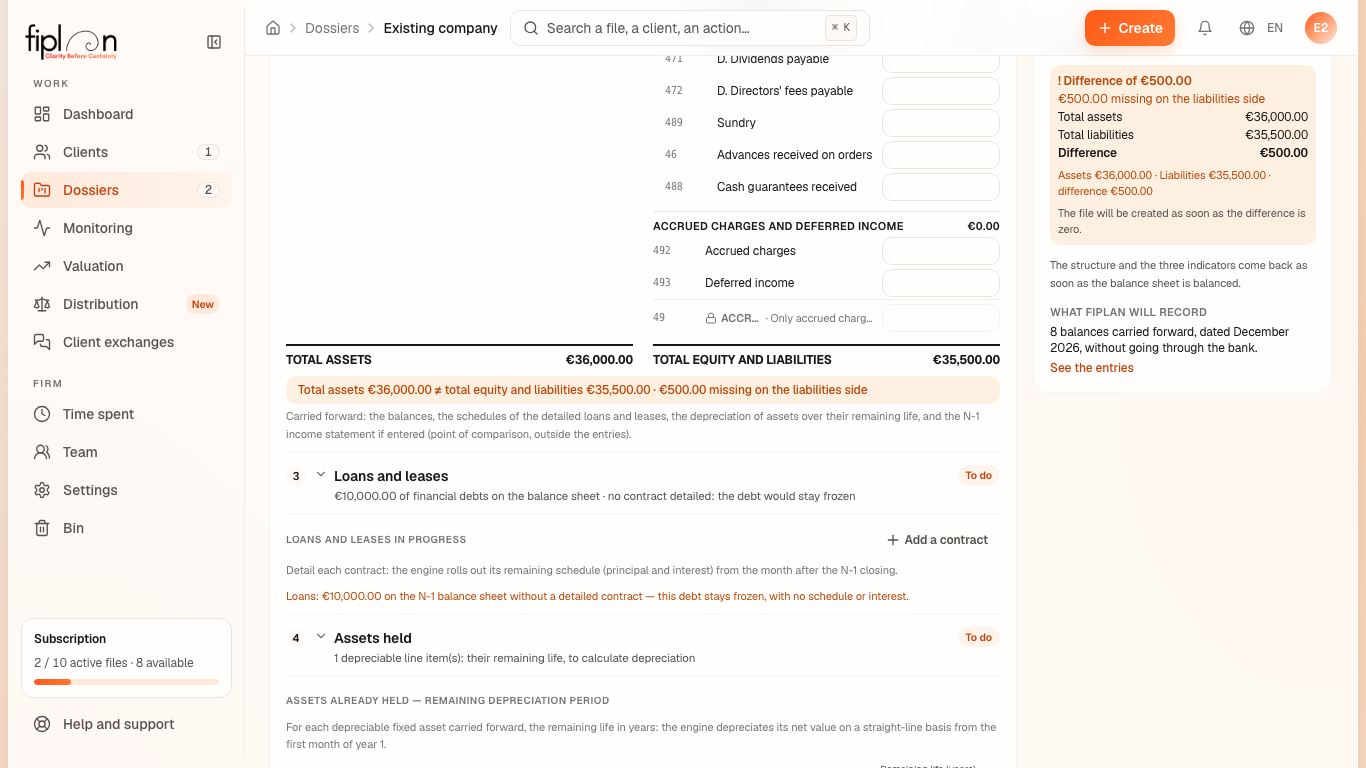
- Read the bar under the table and the Summary: as long as the difference is not zero, the step stays “In progress” and the structure and the indicators are hidden.
- Check the structure and the three indicators; open See the entries if you want to see the opening entries themselves.
- Go on to steps 3 and 4 (the contracts and the assets: see the next article), then create the file.
Worked example · Boulangerie Dupont SRL
If Boulangerie Dupont already existed, with a closing on 31 December 2026, its N-1 balance sheet could be:
| Assets | Amount | Liabilities | Amount |
|---|---|---|---|
23 III.B. Plant, machinery (the oven) | 18,000.00 | 11 I. Contribution — available | 20,000.00 |
30/37 VI. Stocks and contracts in progress | 2,500.00 | 14 IV. Accumulated profits (losses) | 2,000.00 |
40 VII.A. Trade debtors | 1,200.00 | 17 Amounts payable after more than one year — credit institutions | 10,000.00 |
54/58 IX. Cash at bank and in hand | 14,300.00 | 44 Amounts payable within one year — B. Trade debts | 4,000.00 |
| Total assets | 36,000.00 | Total equity and liabilities | 36,000.00 |
The section subtotals: fixed assets €18,000.00, current assets €18,000.00; equity €22,000.00, amounts payable after more than one year €10,000.00, amounts payable within one year €4,000.00. Difference: €0.00.
The Summary derives:
| Indicator | Calculation | Value |
|---|---|---|
| Solvency | €22,000.00 ÷ €36,000.00 | 61.1% |
| Current ratio | €18,000.00 ÷ €4,000.00 | 4.50 |
| Net working capital | (€22,000.00 + €10,000.00) − €18,000.00 | €14,000.00 |
The structure: on the assets side, fixed 50% and current 50%; on the liabilities side, equity 61.1%, debts > 1 year 27.8%, debts ≤ 1 year 11.1%. And what Fiplan will record: “8 balances carried forward, dated December 2026, without going through the bank.” The 2027 plan starts with these balances.
A typing error — trade creditors entered as €3,500.00 instead of €4,000.00 — and the bar turns orange: “Total assets €36,000.00 ≠ total equity and liabilities €35,500.00 · €500.00 missing on the liabilities side”. The Summary then hides the structure and the indicators (they would be wrong), and the button says: “Missing: a balanced balance sheet (difference €500.00).”
Pitfalls
490) come back as a charge, month by month, until the end of the period they cover: below the balance sheet, choose the charge account (released as a charge to, 613900 by default) and the last month (until, the closing of financial year 1 by default); the screen reminds you not to plan this charge a second time in your lines. Accrued income (491) is collected like customers, in the first month of financial year 1. An import of code 490-491 lands on deferred charges: split it.492) are paid like suppliers, in the first month of financial year 1. Deferred income (493) comes back as income, month by month, until the end of the period it covers: below the balance sheet, choose the income account (released as income to, 700000 by default) and the last month (until, the closing of financial year 1 by default); the screen reminds you not to plan this income a second time in your lines. An import of code 492-499 lands on accrued charges: split it. The other accrual or suspense accounts on the liabilities side stay greyed out, with a padlock.What it changes · opening 2027
Source
Royal Decree implementing the Companies and Associations Code (AR CSA / KB WVV): the abridged format of the annual accounts (asset and liability headings).
Fiplan convention (a-nouveaux.ts, balance-template.ts, creation-existante.ts): the headings taken over, their account, the Excel template and the refusal of an unbalanced balance sheet; the balance sheet in the NBB layout, its structure and the three indicators, calculated with the functions of the Analysis screen (financial-ratios.ts, working-capital.ts).