
Creating a file: a company to incorporate or an existing company
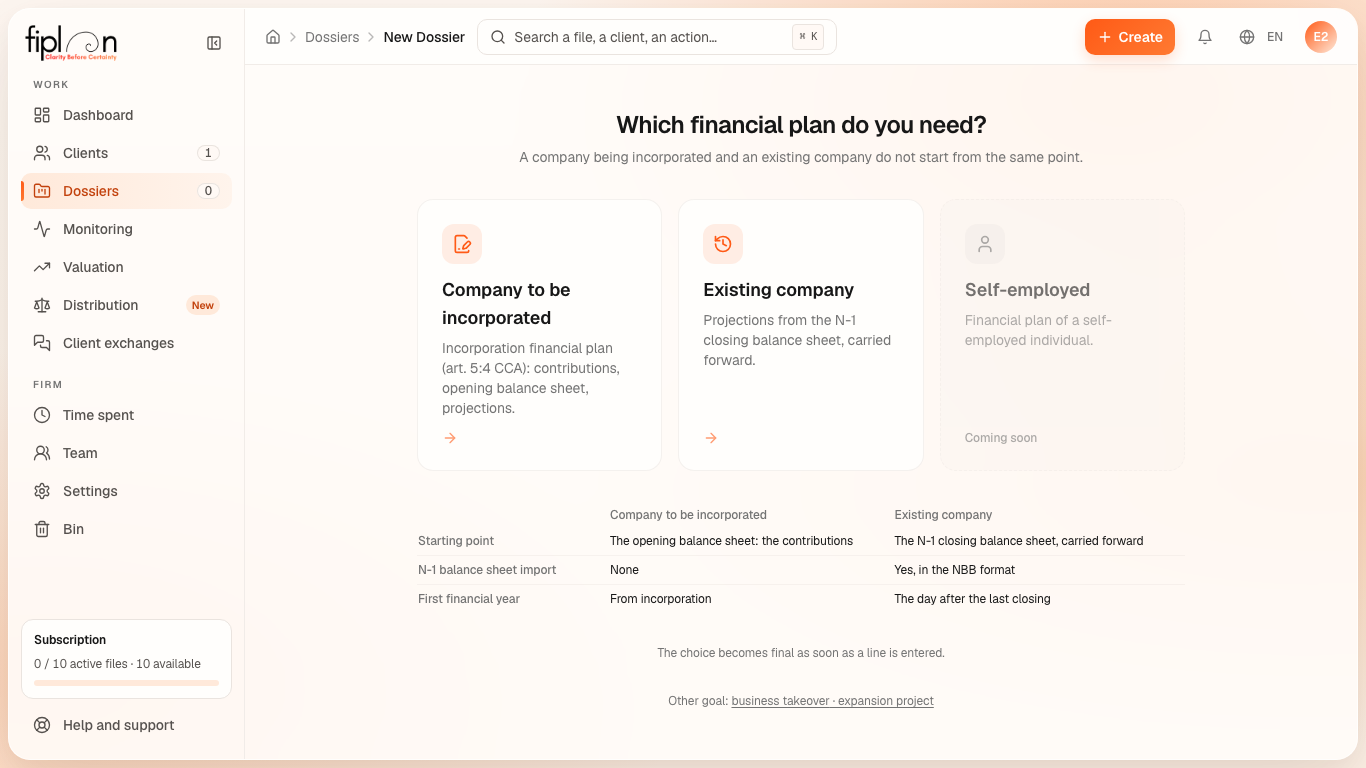
A company being born and a company that already exists do not start from the same point. Fiplan asks the question before anything else: an incorporation plan starts with the contributions and the founders; an existing company's plan, with the closing balance sheet of its last financial year.
What it is for
The file sets the framework of the plan: the legal form, the dates of the financial years, the duration, the VAT status, and the starting point — the opening balance sheet of a company to be incorporated, or the prior-year (N-1) closing balance sheet of an existing company. All data entry is attached to it.
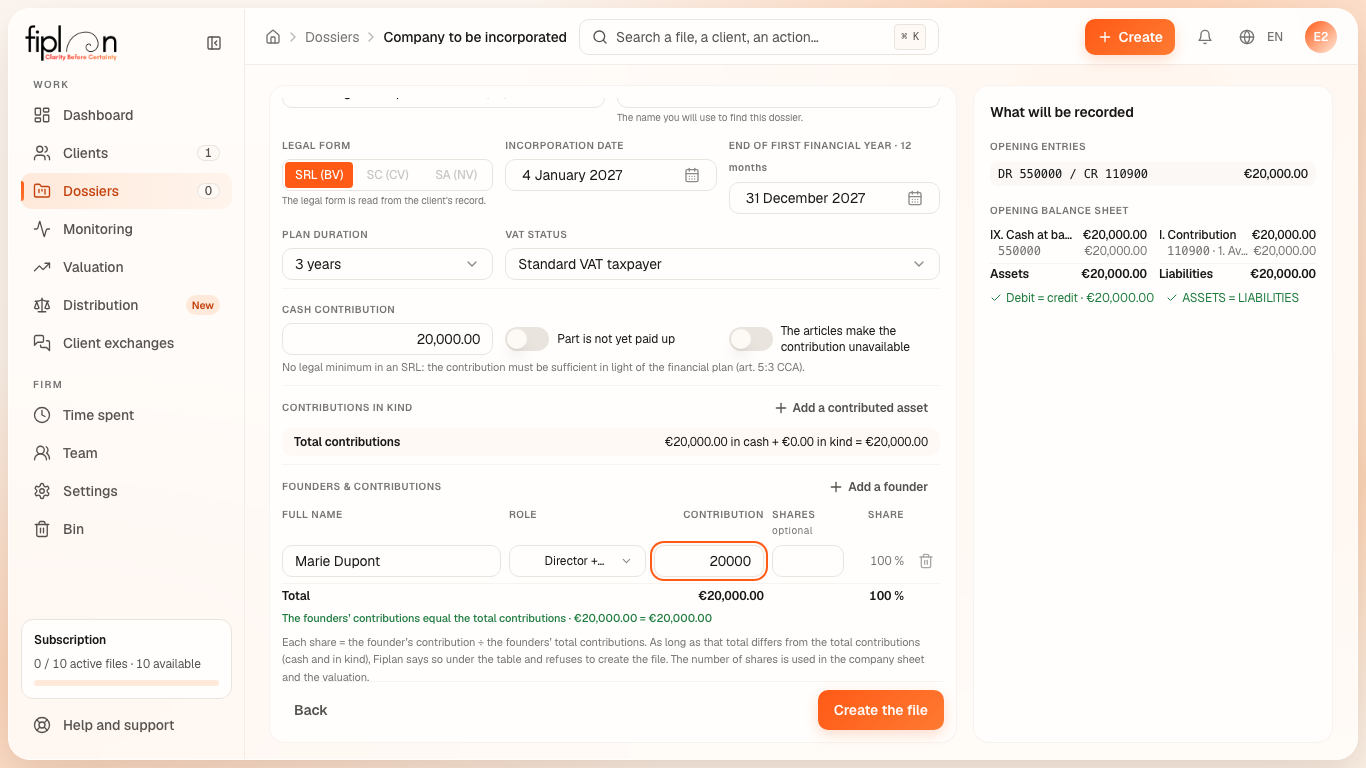
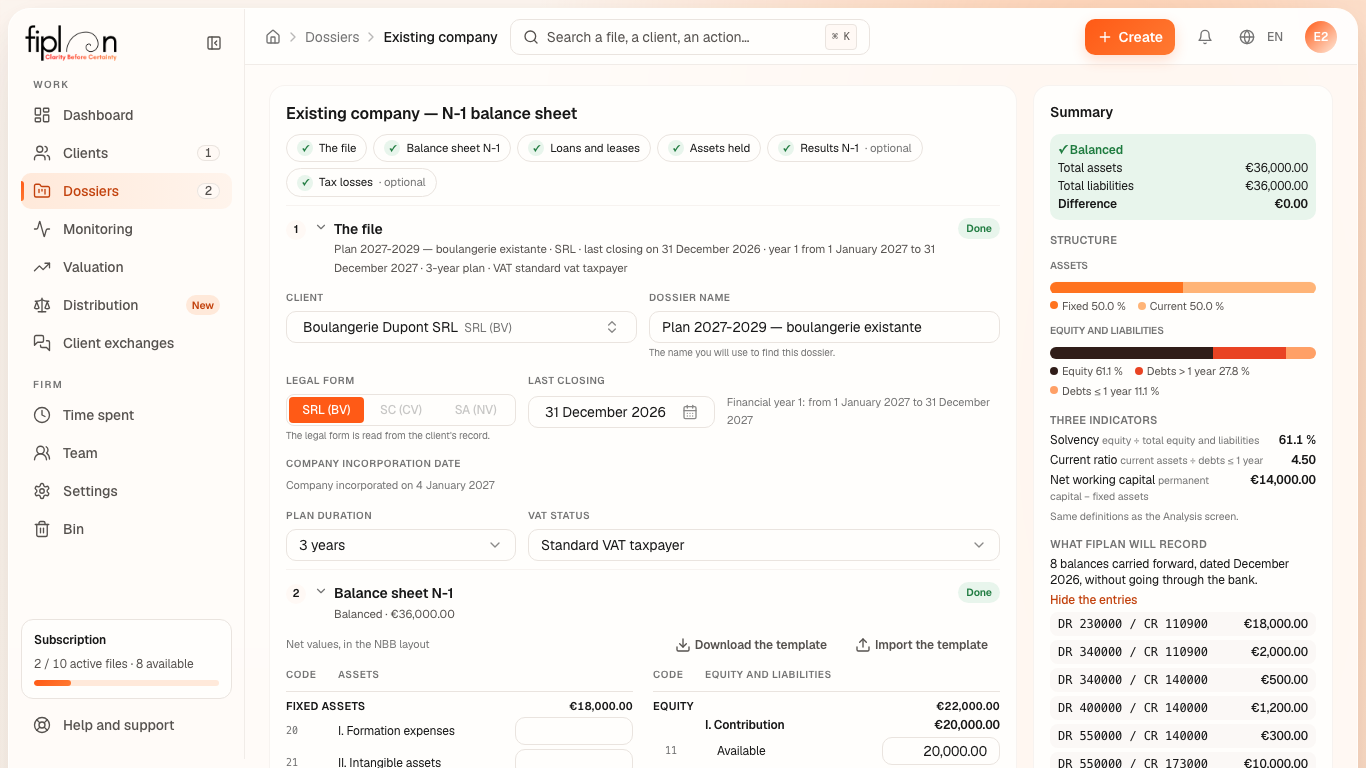
Both screens have the same layout: on the left what you enter, on the right what Fiplan derives from it. For an incorporation, the right-hand column is called “What will be recorded”: the Opening entries and the Opening balance sheet. For an existing company, it is the Summary: whether the N-1 balance sheet balances, its structure, three indicators and what Fiplan will record.
Steps
- Click New Dossier: the “Which financial plan do you need?” screen offers Company to be incorporated, Existing company and, soon, Self-employed.
- Common to both: the Client, the Dossier name, the Plan duration, the VAT status and the Legal form — private limited company (SRL / BV), cooperative company (SC / CV) or public limited company (SA / NV), read from the client's record if it is there, and then locked.
- Company to incorporate: the Incorporation date; Fiplan proposes the End of first financial year on the last day of the twelfth month (from 1 to 24 months). Then the Cash contribution (apport en numéraire / inbreng in geld) for an SRL or SC, or the Subscribed capital (capital souscrit / geplaatst kapitaal) for an SA, and any Contributions in kind (apports en nature / inbreng in natura), one asset per line: Account, Contributed asset, Value, Life. A line adds them up: “Total contributions — … in cash + … in kind = …”.
- Still for an incorporation, the Founders & contributions table: one line per founder — Full name, Role, Contribution, Shares (optional) — and their Share, which Fiplan calculates; Add a founder adds a line, the Total line adds them up. Under the table, Fiplan compares the founders' contributions with the total contributions.
- Existing company: a page in six steps, summarised by a contents bar at the top — 1 The file · 2 Balance sheet N-1 · 3 Loans and leases · 4 Assets held · 5 Results N-1 · 6 Tax losses, the last two optional. Each step shows its status (Done, In progress, To do or Optional) and folds up; folded, step 1 is summarised in one line, with Edit. Step 1 asks for the Last closing — financial year 1 starts the next day and lasts 12 months — and, if the client has none, the Company incorporation date (optional). The next steps each have their own article: the N-1 balance sheet, the contracts and the assets, the N-1 income statement and tax losses.
- Read the right-hand column: for an incorporation, debit = credit and ASSETS = LIABILITIES; for an existing company, “✓ Balanced”.
- Click Create the file. As long as a piece of data is missing, the button stays greyed out and the screen says which one (“Missing: …”).
Worked example · Boulangerie Dupont SRL
Boulangerie Dupont is a company to incorporate.
| Field | Value | Where it comes from |
|---|---|---|
| Incorporation date | 4 January 2027 | assumption of the example |
| End of first financial year | 31 December 2027 | proposed by Fiplan: last day of the 12th month |
| First financial year | 12 months | calculated |
| Plan duration | 3 years | 2027, 2028, 2029 |
| VAT status | Standard VAT taxpayer | the bakery charges VAT |
| Cash contribution | €20,000.00 | fully paid up, available |
The contributions total line: “Total contributions — €20,000.00 in cash + €0.00 in kind = €20,000.00”. Marie Dupont, the only founder, contributes everything:
| Full name | Role | Contribution | Shares | Share |
|---|---|---|---|---|
| Marie Dupont | Director + Shareholder | 20,000.00 | — | 100% |
| Total | 20,000.00 | 100% |
Under the table, in green: “The founders’ contributions equal the total contributions · €20,000.00 = €20,000.00”. Entered for only €15,000.00, the line would turn orange (“… do not equal the total contributions”) and the button would say: “Missing: allocate €5,000.00 among the founders.”
The opening balance sheet that Fiplan writes:
| Assets | Amount | Liabilities | Amount |
|---|---|---|---|
| Cash at bank and in hand | 20,000.00 | Available contribution (110900) | 20,000.00 |
| Total assets | 20,000.00 | Total liabilities | 20,000.00 |
If the bakery already existed and had closed its last financial year on 31 December 2026, financial year 1 of the plan would start on 1 January 2027, and its closing balance sheet would be taken over as opening entries (à-nouveaux / openingsboekingen). With the N-1 balance sheet of the next article, step 3 would stay “To do” as long as its loan is not detailed (“€10,000.00 of financial debts on the balance sheet · no contract detailed: the debt would stay frozen”), and so would step 4, as long as the oven's remaining life is missing (1 depreciable line item).
Pitfalls
What it changes · opening
Source
Companies and Associations Code (CSA / WVV): art. 5:4 (financial plan of the SRL), 6:5 (SC), 7:3 (SA); art. 5:3 (no capital in an SRL); art. 7:2 (minimum capital of the SA); art. 7:11 (paying up the capital of the SA at incorporation); art. 1:24, § 4 (length of an exceptional financial year).
Minimum standard chart of accounts (plan comptable minimum normalisé / minimumindeling van een algemeen rekeningenstelsel, annex 1 to the Royal Decree of 21 October 2018), and the opinion of the Belgian Accounting Standards Commission (CNC / CBN) on the move from the former SPRL (SPRL / BVBA), which had capital, to the SRL without capital: the contribution outside capital, available (110) or unavailable (111).
Fiplan convention (creation-dossier.ts, creation-existante.ts): the founders table and each founder's share; the founders' contributions equal to the total contributions, to the cent; the six steps of an existing company and their status.