
Entering a change in stock
A bakery always keeps flour, butter and sugar in reserve. That stock is not an expense of the year: it is still there at year-end. Fiplan calculates it at each year-end, from a rule you choose.
What it is for
Without stock, all the flour bought in 2027 would be counted as an expense of 2027, even what is still in reserve on 31 December: the profit would be too low. The stock policy tells Fiplan what stock the business holds at the end of each financial year; Fiplan then posts the change in stock (variation de stock / voorraadwijziging), which corrects the cost of purchases.
Steps
- In the file, open Encoding, then the Inventory variation module, and click New (or press the N key).
- Choose the stock's account in the Belgian minimum chart of accounts (PCMN / MAR) — for a bakery,
300000(raw materials) — and give the line a description. - In Stock policy, choose the Target method: Days of purchases (proposed by default, with 45 days), Percent of revenue or Fixed amount; then the Target value.
- If you wish, enter a Minimum stock: the stock retained never falls below it.
- Tick the linked lines: your supply lines for days of purchases, your revenue lines for a percentage of revenue. If the list is empty, enter your purchases or your revenue first.
- Read the preview on the right: the closing stock and the change for each financial year. Click Save.
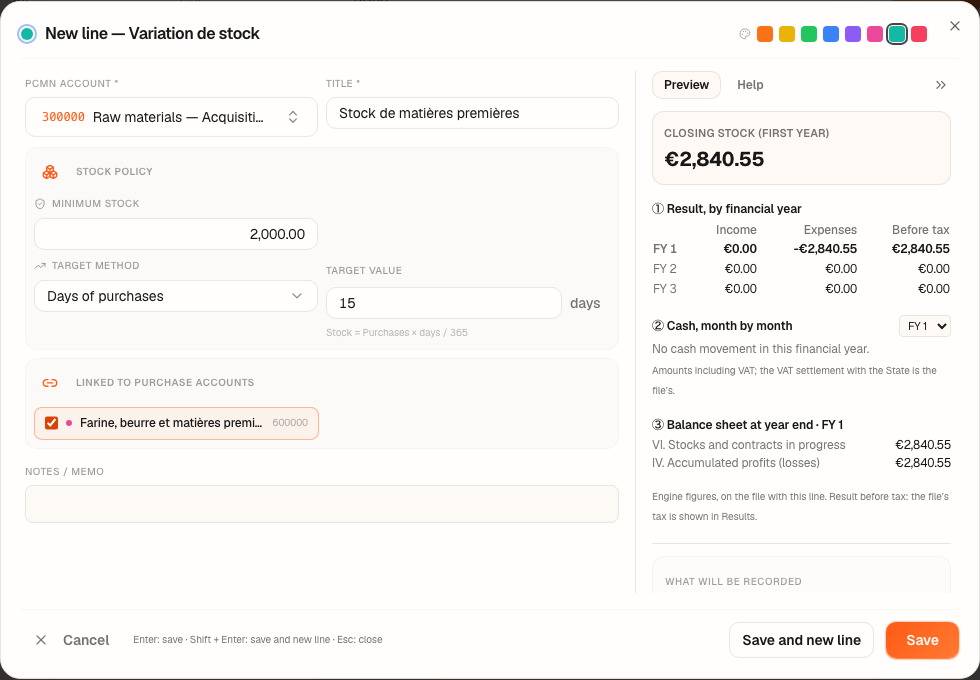
There is no period to choose: stock is calculated at each financial year-end.
Worked example · Boulangerie Dupont SRL
Raw material purchases: 32% of revenue, i.e. €69,120.00 excl. VAT per financial year. Policy: 15 days of purchases, minimum €2,000.00. A company being incorporated: no opening stock.
| Financial year | Purchases | Opening stock | Closing stock | Change | Purchases consumed |
|---|---|---|---|---|---|
| 2027 | 69,120.00 | 0.00 | 2,840.55 | 2,840.55 | 66,279.45 |
| 2028 | 69,120.00 | 2,840.55 | 2,840.55 | 0.00 | 69,120.00 |
| 2029 | 69,120.00 | 2,840.55 | 2,840.55 | 0.00 | 69,120.00 |
The example's activity is stable: the stock for 2028 and 2029 stays at the 2027 level, the change is zero and the cost of purchases is no longer corrected. The calculation of €2,840.55 is detailed in How Fiplan calculates: the stock policy.
Pitfalls
What it changes · 2027
Source
Minimum standard chart of accounts (plan comptable minimum normalisé / minimumindeling van een algemeen rekeningenstelsel, annex 1 to the Royal Decree of 21 October 2018): class 3 (stocks) and account 609 (changes in stocks).
Fiplan conventions, declared in the code (politique-stock.ts): the change is posted at each financial year-end; a month counts 365/12 days; the stock retained is rounded to the cent.