
Entering a bank loan
A loan brings money into the business, then takes money out every month. You enter its terms; Fiplan calculates the monthly payment, separates the principal repaid (which reduces the debt) from the interest (which is an expense) and tracks the outstanding principal at each year-end.
What it is for
The Financing & Contributions module holds everything that brings money in: contributions, subsidies, loans, leases, current accounts. The PCMN account chosen (Belgian minimum chart of accounts, PCMN / MAR) decides the type: a 173… account (credit institutions) is a bank loan.
Steps
- Open Encoding, then Financing & Contributions, and click New.
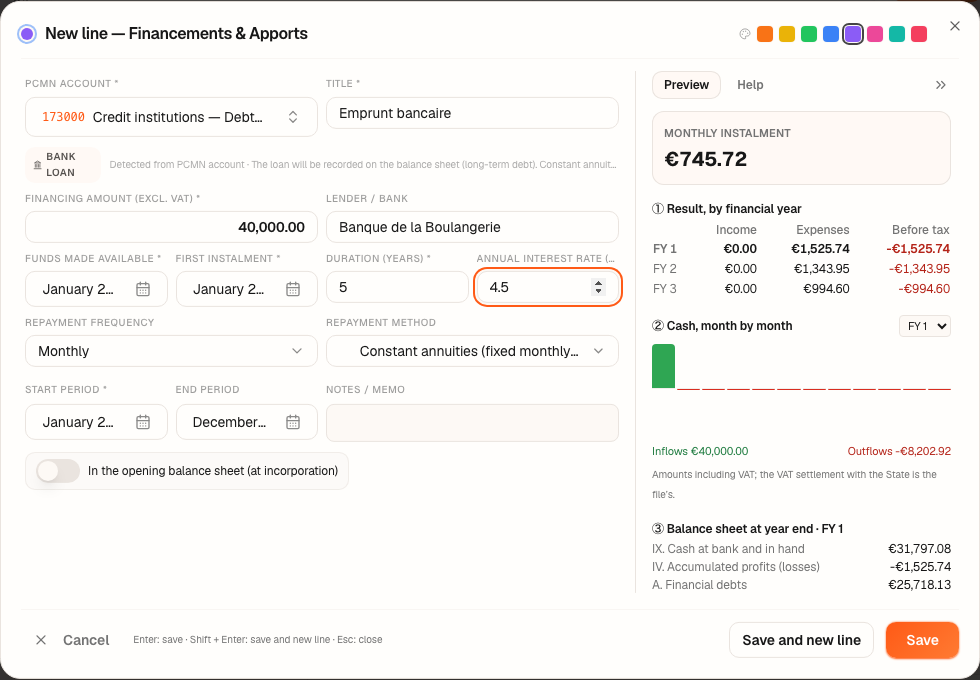
- Choose the PCMN Account —
173000, credit institutions —: Fiplan shows “Bank loan”. Give a Title. - Enter the Financing amount (excl. VAT) and the Lender / Bank.
- Choose the Funds made available month (the month the money arrives) and the First instalment.
- Enter the Duration (years), a number of years, and the Annual interest rate (%).
- Choose the Repayment frequency (Monthly, quarterly or yearly) and the Repayment method: Constant annuities (fixed monthly payment) or Constant amortization (fixed principal).
- Read the schedule on the right — principal, interest, instalment, then the totals per financial year — and click Save. Fiplan creates the line “Interest – …” (account 650000).
Worked example · Boulangerie Dupont SRL
A loan of €40,000.00 at 4.5% a year, over 60 months (5 financial years), constant monthly payments, funds received in January 2027. The monthly payment on a principal , at the monthly rate , over months:
The first instalment falls in February 2027: interest , principal repaid €595.72. Each month, the interest is calculated on the outstanding principal, rounded to the cent.
| Financial year | Instalments | Interest | Principal repaid | Total paid | Outstanding principal at 31 December |
|---|---|---|---|---|---|
| 2027 | 11 | 1,525.74 | 6,677.18 | 8,202.92 | 33,322.82 |
| 2028 | 12 | 1,343.95 | 7,604.69 | 8,948.64 | 25,718.13 |
| 2029 | 12 | 994.60 | 7,954.04 | 8,948.64 | 17,764.09 |
Over its whole duration, the loan costs €4,743.27 in interest.
Pitfalls
What it changes · 2027
Source
Minimum standard chart of accounts (plan comptable minimum normalisé / minimumindeling van een algemeen rekeningenstelsel, annex 1 to the Royal Decree of 21 October 2018): accounts 173 (credit institutions), 42 (debts payable after more than one year falling due within the year), 650 (debt charges).
Fiplan conventions, declared in the code (echeancier-financement.ts): the monthly payment rounded to the cent once; the interest of each instalment on the outstanding principal before it, rounded to the cent (half up); the last instalment settles the principal.