
Entering a lease (finance lease)
An asset taken under a finance lease (location-financement / financieringshuur) enters the balance sheet as if the business had bought it on credit: an asset, a debt. But no money arrives at the bank — money only goes out, with each lease payment. Fiplan treats it this way, following Opinion 2015/4 of the Belgian Accounting Standards Commission (CNC / CBN).
What it is for
In the Financing & Contributions module, a 172… account (finance lease debts) is recognised as Leasing / Finance lease. The window then asks for what the contract and the asset require: the amount, the rate, the contract term, and the asset's useful life, which may be longer.
Steps
- Open Encoding, then Financing & Contributions, and click New.
- Choose the PCMN Account
172000, an account of the Belgian minimum chart of accounts (PCMN / MAR): Fiplan shows “Leasing / Finance lease”. Give a Title. - Leave New contract as it is (the box is used to take over a contract already running; see the pitfalls).
- Enter the Financing amount (excl. VAT), the Leasing company and the VAT rate of the lease payments.
- Enter the asset's Useful life (years) and choose the Nature of the asset — the journal records the asset on the account of that heading 25 (250, 251 or 252; 251000 for the bakery's oven); then, if there are any, the Increased first instalment and the Purchase option.
- Choose Funds made available (the month the asset is delivered), the First instalment, the contract's Duration (years), the Annual interest rate (%) and the Repayment frequency.
- Read the repayment schedule on the right and click Save.
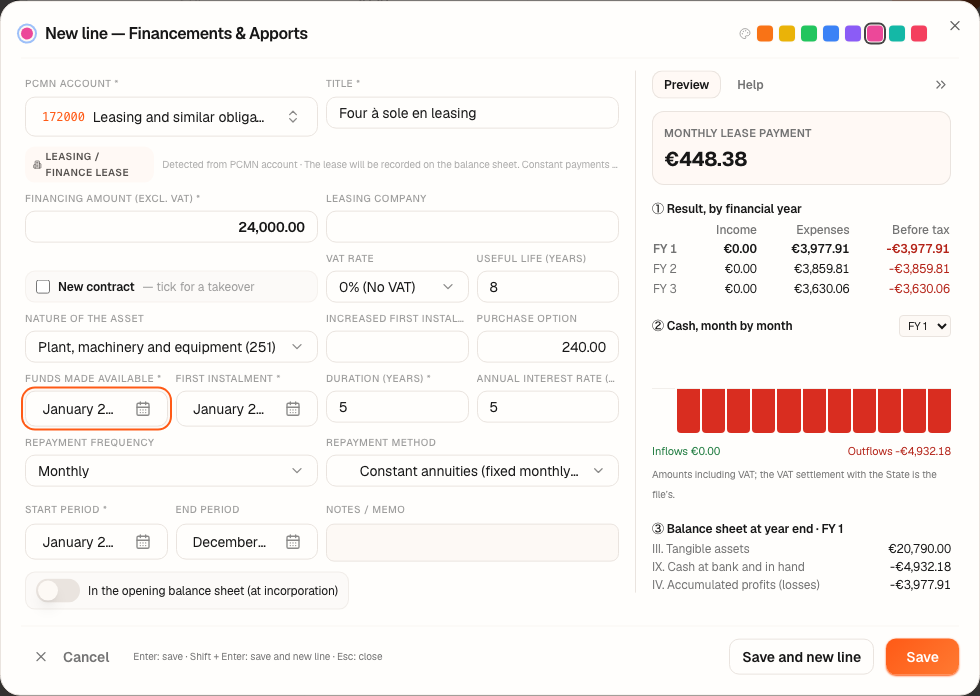
Worked example · Boulangerie Dupont SRL
A deck oven under a finance lease: €24,000.00, over 5 years, at 5%, monthly lease payments, delivered in January 2027, purchase option of €240.00, useful life of the oven 8 years, VAT left at 0% (the screen's default).
The asset and the debt are worth the part of the contract that repays the principal: the amount less the purchase option, which is not recorded in the balance sheet.
The first lease payment falls in February 2027, the month after delivery: €448.38, of which €349.38 is principal and €99.00 interest. The oven is depreciated over its 8 years of useful life, not over the 5 years of the contract.
| 2027 | Amount |
|---|---|
| Lease payments made (11): principal portion | 3,924.27 |
| Lease payments made: interest portion (650000) | 1,007.91 |
| Depreciation charge (630200) | 2,970.00 |
| Net book value of the oven at 31 December | 20,790.00 |
| Lease debt at 31 December | 19,835.73 |
| of which repayable in 2028, shown under amounts falling due within one year (422000) | 4,490.75 |
Pitfalls
What it changes · 2027
Source
CNC Opinion 2015/4 (finance leases): the asset and the debt are worth the part of the lease payments that repays the principal; each payment splits into principal and interest; the asset is depreciated over its useful life; the purchase option is not carried in the balance sheet.
Minimum standard chart of accounts (plan comptable minimum normalisé / minimumindeling van een algemeen rekeningenstelsel): accounts 172 (finance lease debts), 25 (fixed assets held under finance leases), 422 (portion falling due within one year), 650 (debt charges).
Income Tax Code 1992 (CIR 92), Article 66 (amended by the Law of 25 November 2021): the deductible share of the costs of a car, a dual-purpose vehicle or a minibus, entered by the accountant (voiture-dna.ts).
Fiplan conventions, declared in the code (leasing.ts): a period's interest is calculated on the principal outstanding before it (paid in arrears); the first lease payment falls in the month after delivery; the increased first payment counts as repaying principal (a point the opinion leaves open); accumulated depreciation goes to account 259000.