
Miscellaneous operations
Some entries go through no module: an expense of the financial year whose invoice will arrive later, income earned but not yet received. The miscellaneous operation posts them directly, between an income statement account and a balance sheet account.
What it is for
The Miscellaneous operation form asks for two accounts: the impact account (an expense or an income account, which goes to the income statement) and the Counterpart account (balance sheet). The preview shows the entry, with its debit and credit.
Steps
- Open Encoding, then Miscellaneous Operations, and click New.
- Choose the impact account: the badge shows “Expense” or “Income”.
- Choose the Counterpart account (balance sheet): the badge shows “Asset”, “Liability” or “Equity”.
- Choose the Direction: “Increases the expense” (the default) or “Decreases the expense” — for income, “Increases the income” or “Decreases the income”.
- Choose the Fiscal year and enter the Amount and the Title.
- Read the summary on the right — the direction and the entry, with its debit and credit — and click Save.
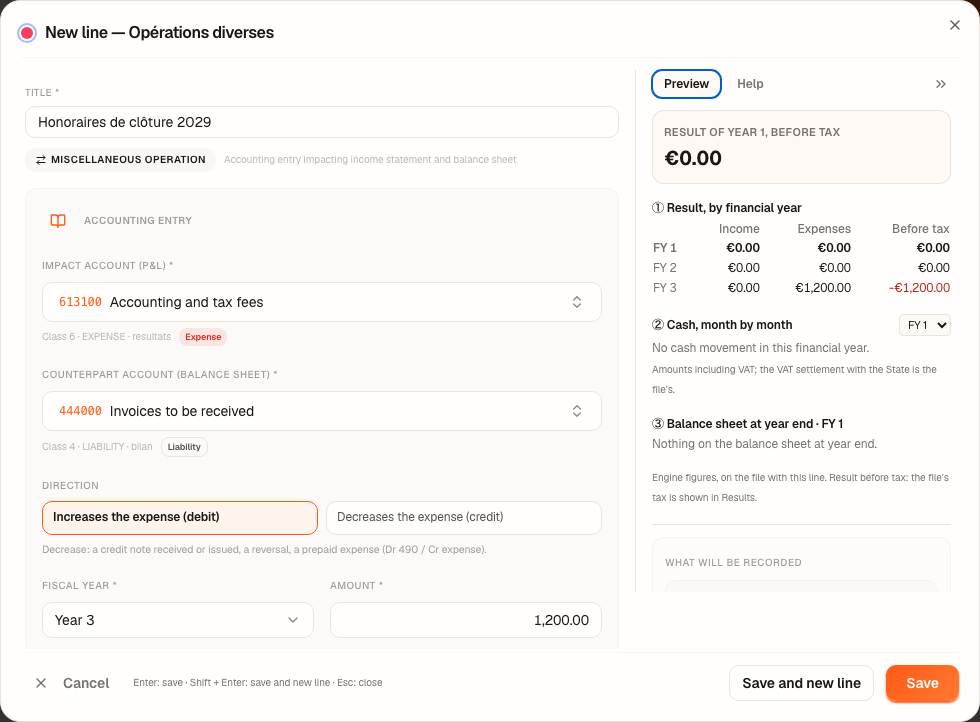
Worked example · Boulangerie Dupont SRL
The accountant's fees for the 2029 year-end closing, €1,200.00, will be invoiced in 2030: yet the expense belongs to financial year 3. Impact account 613100 (accounting fees), counterpart 444000 (invoices to be received).
Fiplan dates the operation in the first month of the chosen financial year, January 2029, and posts it as the preview shows it, in one entry:
| Debit | Credit | Amount |
|---|---|---|
| 613100 | 444000 | 1,200.00 |
Cash does not move (€0.00): neither the allocation account nor the counterpart is the cash account 550000.
Pitfalls
What it changes · 2029
Source
Minimum standard chart of accounts (plan comptable minimum normalisé / minimumindeling van een algemeen rekeningenstelsel): accounts 613 (fees paid to third parties), 444 (invoices to be received). Account 613100 is a Fiplan subdivision.
Fiplan conventions, declared in the code (LineItemModal.tsx, journal-engine.ts): the operation is dated in the first month of the chosen financial year; the operation posted in one entry, allocation and counterpart (MOTEUR-3, D248); cash moves only if one of the two accounts is the cash account 550000.